The 1% That Changes Everything: A Global Pollution Tax for Our Shared Future
12/8/2025
Introduction
We are living in the age of irreversible environmental transformation. Year after year, the signs grow clearer: megafires, heat waves that make cities uninhabitable, Caribbean storms that swallow entire coasts, and droughts that empty rivers once thought eternal. Each disaster arrives with a price tag measured not only in billions of dollars but also in human futures, lost homes, lost harvests, and lost history. Yet despite more than three decades of climate agreements, from COP3 in Kyoto to COP28 in Dubai and even the upcoming COP30 in Brazil, emissions continue to rise. Our global governance looks busy, but the atmosphere only records results.
The uncomfortable truth is this: the world does not lack science, technology, or even political promises. We lack money delivered on time and at scale. Climate finance remains an illusion of voluntary pledges, fluctuating carbon markets, and donor fatigue masked behind lofty press releases. When revenues depend on elections, crises, or short-term interests, they crumble the moment they are most needed.
Meanwhile, climate injustice deepens. Regions that did the least to cause the crisis are the first to drown or burn. The communities that protect the lungs of our planet, the forests of the Amazon, Congo, and Borneo, are those with the least access to stable financing. Frontline adaptation projects in small islands and rural provinces are often canceled simply because a donor changed governments. The negotiations continue, year after year, yet the cash that keeps ecosystems alive remains stuck in political translation.
We know how to respond to a planetary emergency, but we continue to fund the response like a charity campaign. The world needs a financing system that is stable, universal, and insulated from political mood swings. We need a simple fiscal truth for a complex ecological era, one that does not wait for the next COP photo opportunity to unlock survival.
A One Percent Solution Hiding in Plain Sight
Imagine this. Every time anyone, anywhere buys something, a sandwich, a smartphone, a plane ticket, one percent automatically supports climate protection. No debates, no delays, no waiting for another COP gathering that promises money yet delivers too little. At the register, climate finance becomes a routine fact of life, just like sales tax or receipts. The economic logic is simple. The engine of global warming is consumption, so the engine of climate finance should be consumption as well.
A one percent global pollution tax applied at the point of sale would raise more money than all climate agreements combined. The world economy now exceeds one hundred trillion dollars every year, which means a permanent environmental budget of at least one trillion dollars. That amount would finally turn climate action from a pledge into a plan. And because wealthier consumers spend more, those with the greatest means contribute the most. Fairness becomes a built in outcome instead of a political fight.
There is nothing radical in how this would function. It does not require a new global bureaucracy or a supranational treasury. Each country would collect the revenue through systems that already exist. What changes is what happens next. Instead of getting buried inside unrelated political agendas, the revenue is kept separate and directed only toward climate protection under clear rules everyone can observe.
To the citizen it is a rounding error. To the planet it is the difference between symbolic ambition and genuine transformation. One percent is not charity and it is not sacrifice. It is simply the minimum investment required to ensure that a livable Earth remains possible, without waiting for the next international summit to decide whether survival fits the budget.
Empower the Climate Guardians Who Actually Do the Work
There is a simple truth that rarely shapes global policy. Climate protection does not happen in diplomatic halls. It happens in forests, on coastlines, in deserts, and in the communities that live beside them. From Alaska to Zanzibar, it is provinces, states, and local governments that manage the ecosystems on which all life depends. They are the ones who protect rivers from drying out and rebuild homes after storms tear through coastal towns. They feel climate change before they hear it discussed.
Still, these essential stewards operate with fragile budgets controlled by national capitals that often sit far away from the real damage. This distance creates a dangerous delay. The places most capable of responding cannot act because money must move through politics before it reaches survival. A fair system would reverse this flow so that funding leads and political decisions follow. The front line should finally become the first line.
A universal one percent pollution contribution would give these communities reliable resources at last. An independent authority would determine how each country’s revenue is shared across its regions. Areas that hold biodiversity and forests would receive meaningful support. Regions making rapid progress in renewable energy would see their allocations rise. Places facing the harshest climate risks would not have to beg for relief. The logic is simple. Those who preserve the planet or endure the worst effects of its warming should not be left fighting for scraps.
Imagine the Amazon being funded not for a year or two but permanently. Imagine coastal provinces planning for rising seas without wondering if next year’s budget will evaporate. Imagine communities rewarded for transforming their energy systems rather than punished by the cost of change. Performance becomes progress that pays forward.
When climate finance follows justice and responsibility rather than hierarchy and distance, it is no longer charity. It becomes the rightful support owed to those who protect the shared home of humanity.
Allocation Scenarios and What They Reveal About Fairness
The power of a universal one percent contribution becomes clear when we explore how the money flows in different real world situations. The Climate Allocation Index directs resources to regions that protect biodiversity, advance clean energy, or endure the harshest climate impacts. The formula is simple enough to explain in a sentence. It weighs what each region contributes to planetary stability and what each region suffers from planetary change.
Mathematically, the idea can be written as a single expression that anyone can follow.
CAI(i) = w1 F(i) + w2 R(i) + w3 V(i)
F measures forests and biodiversity. R reflects renewable energy progress. V captures vulnerability. The weights w1, w2, and w3 are just global priorities and they always add up to one. The index values for all regions also add up to one. This means every region is seen, nothing is double counted, and fairness becomes a rule rather than a request.
Once every region has its CAI share, funding follows automatically.
Entitlement(i) = GPP × CAI(i)
GPP is the Global Pollution Pool, the total raised by the one percent contribution. There are no negotiations or political preferences. A global rule delivers what each place is due.
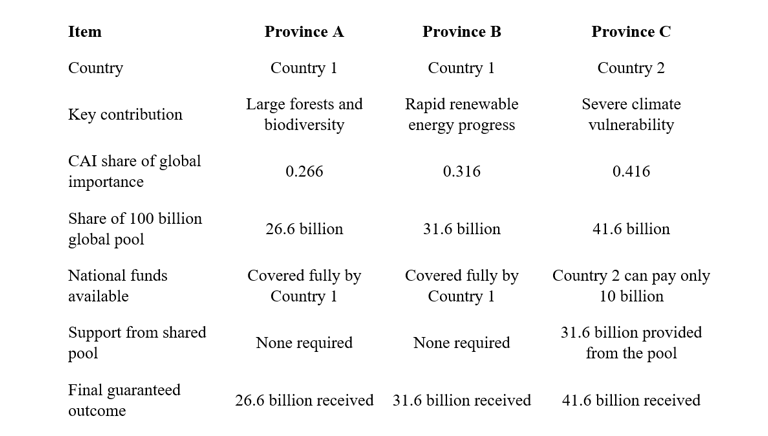
A simple example shows how stable and fair this becomes. Picture a global pool of one hundred billion dollars. There are three provinces. A and B are in Country 1. C is in Country 2. Global environmental data tells us that Province A contains large forests, Province B leads in renewable energy, and Province C faces extreme climate risk. Using equal weighting of these factors, A earns 26.6 billion, B earns 31.6 billion, and C earns 41.6 billion. The numbers add perfectly to one hundred billion because the math is designed that way.
Now consider national wealth. Country 1 collects ninety billion from its one percent tax because its economy is stronger. This fully covers A and B, whose combined entitlement is 58.3 billion. The remaining 31.7 billion from Country 1 becomes part of the shared global pool. Country 2 collects only ten billion because its economy is small, yet it owes 41.6 billion to Province C. The shared pool covers the 31.6 billion difference. Province C receives everything it is owed, not what its country can afford.
This example shows three important truths. Finance stops punishing regions that are poor but essential. Every year of collection produces predictable funding for the ecosystems that protect us. And most importantly, no region ever loses its guarantee. Even in a recession year, even if a national government changes, even if politics waver, the rainforest still receives its share and the vulnerable coastline still reinforces its defenses.
Different scenarios still lead to the same fairness. If the world focuses heavily on saving forests, funding rises for the provinces that keep carbon stored in trees and soil. If clean energy becomes the global priority, the regions that accelerate wind and solar receive greater support. If justice for vulnerable communities becomes the focus, the places on the front lines of heat and storms rise in the allocation. The system adjusts to global needs while keeping every region visible and every survival right intact.
Illustration of How the One Percent System Works
In short, effectiveness is rewarded and vulnerability is respected. The world finally pays money in the same direction nature needs protection.
The Cost of One Percent vs. the Cost of Collapse
The strength of this proposal is that it does not complicate what must be simple. Countries continue to govern their own finances. Citizens continue their everyday lives with only the smallest adjustment. Yet together, a single percentage point on every purchase would build a worldwide shield against the worst that climate breakdown can bring. Survival should not require a miracle. It only requires a modest decision applied universally and consistently.
Some will insist that people will not accept a tax. The truth is more painful. If we refuse small changes now, we will pay with everything later. Scientists warn that half of all people alive today may face dangerous heat within a few decades. The economic losses will be staggering, but the human losses will be unbearable. Children who inherit this future will ask why one percent felt like too large a price to protect the world that raised us.
Our crisis does not persist because solutions are unknown. It persists because courage lags behind knowledge. Each year of hesitation increases the heat and reduces the hope. At this point the question left before us is not about technology or finance. It is about whether humanity can act at a scale worthy of its own survival. One percent is the smallest step that still matters enough to change the future.
History rarely offers a crossroads as clear as the one we stand before today. We can decide to be the generation that built the foundation for a livable planet, or the generation that allowed the window to close. The global one percent contribution is more than a funding mechanism. It is a declaration that humanity chooses life over delay. With one step taken together, we can secure the only home any of us will ever have.
Jo M. Sekimonyo
Email : sekimonyo@hotmail.com
ORCID : 0000-0002-5358-2986