What is economics?
Jo M. Sekimonyo
2/17/2026
The first thing I usually clarify is that there has never truly been a consensus. Economics has always contained competing traditions, different moral assumptions, and conflicting visions of society.
As economics today stands on the intellectual lineage of thinkers such as Abu Hamid Al-Ghazali, Ibn Khaldun, Adam Smith, or Karl Marx, whose PhD was in philosophy, it becomes difficult to reduce economics to equations alone. Those foundational figures associated with economic thought were not economists because economics had not formally separated itself from philosophy, political thought, and moral inquiry. They were moral philosophers attempting to understand how societies organize production, power, wealth, labor, and survival.
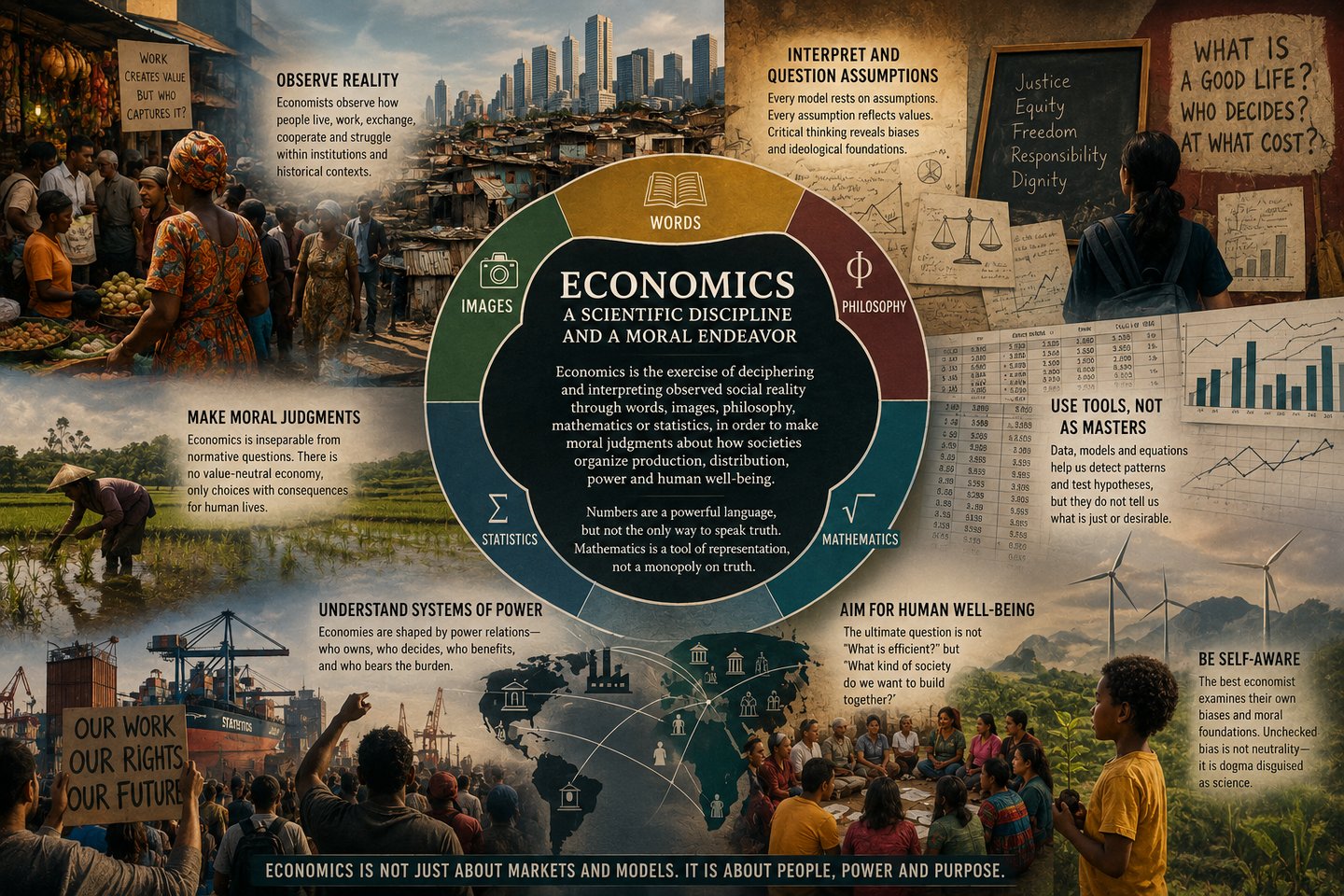
And so, economics is the exercise of deciphering and decrypting observed social reality, whether through words, pictures, philosophy, mathematics, or statistics, in order to make moral judgments about how societies organize production, distribution, power, and human welfare. Numbers eventually became the dominant language of modern economics, but that dominance does not make them inherently superior to other instruments of interpretation. Mathematics is a tool of representation, not a monopoly on truth.
The economist therefore observes patterns, attempts to identify laws, natural or institutional, and then interprets them through an ideological and moral framework to make moral judgments. In that sense, many of the most influential economic texts are fundamentally works of moral philosophy. From The Wealth of Nations by Adam Smith to How to Pay for the War by John Maynard Keynes, or even the works of his intellectual adversaries such as Friedrich Hayek, Milton Friedman, or Jacques Rueff, who criticized Keynes during the debates surrounding German reparations and monetary order in the interwar period, economic writing has always carried moral judgments about obligation, sacrifice, justice, responsibility, and the organization of collective life.
Someone who performs the analytical exercise but does not make moral judgments may hold a degree in economics, teach economics, or publish economic models, but such a person functions primarily as an analyst rather than a true economist. Economics is inseparable from normative questions because every economic system distributes opportunity, suffering, power, and dignity differently.
At the same time, the worst economist is the one who makes moral judgments while remaining unaware of the assumptions, biases, and moral foundations beneath those judgments. An economist incapable of recognizing their own biases, revising them, or interrogating the assumptions embedded within their framework risks mistaking historical preference for universal truth. That is not neutrality. It is unconscious assumptions presented as science.
Jo M. Sekimonyo